
















Survey of War Relics Using Ground Penetrating Radar
Research Center for Archaeology, Setouchi Town Board of Education, Koniya High School
NAKAMURA Naoko
- setouchi
Background and objectives of activities
War relics and structures are vital cultural heritage sites that provide multifaceted historical understanding of the realities of war as “living evidence.” Numerous well-preserved structures remain in Setouchi Town, Amami, some of which are designated as national historic sites. However, many aspects of the underground structures, such as the former Amami Oshima Fortress Command Headquarters located in the city center, remain unexplored. At the request of the Setouchi Town Board of Education, our center will conduct ground-penetrating radar surveys. This non-destructive method allows for extensive investigation while minimizing disruption to daily life, enabling us to assess the underground conditions.
Summary of Activities
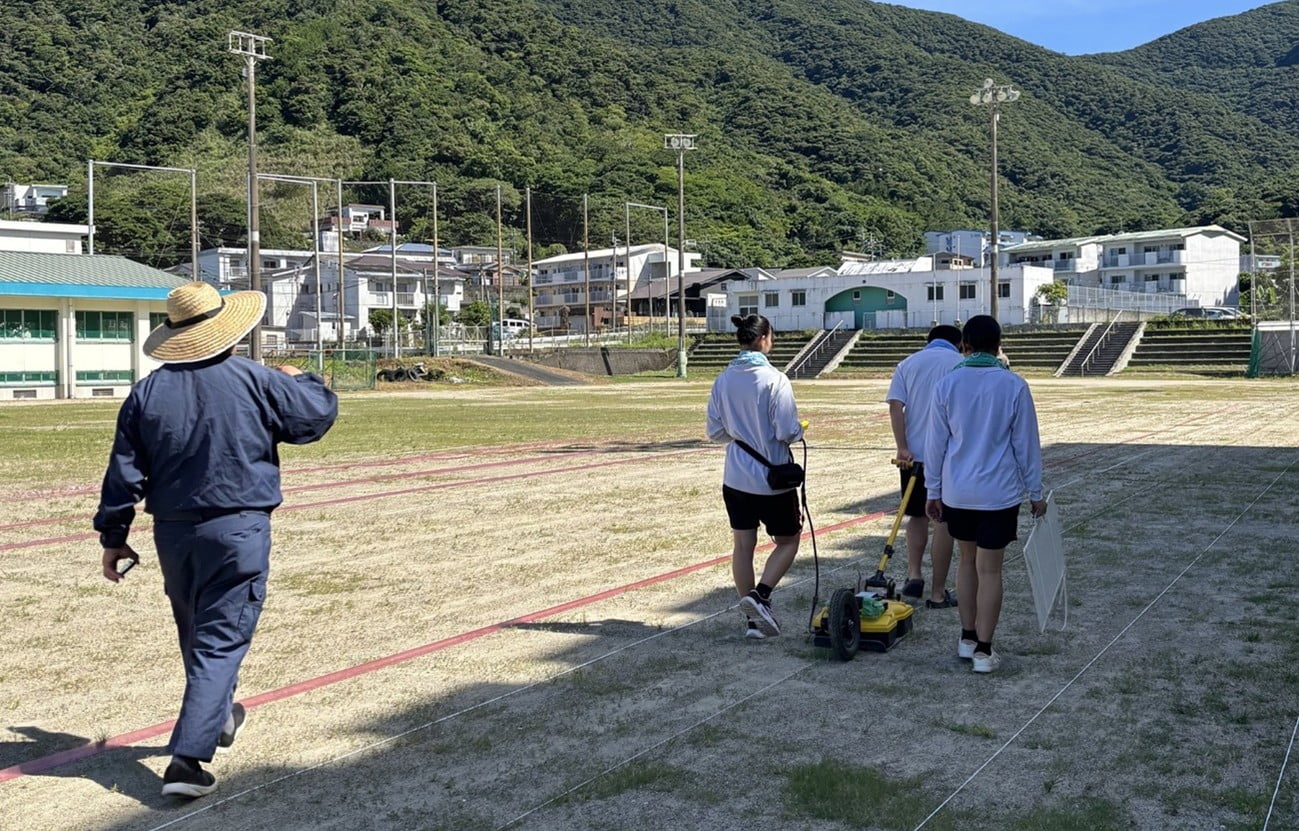
The Amami Ōshima Fortress Command Headquarters is now located within an urban area, necessitating the identification of its remains through small-scale excavation surveys wherever possible. In June 2025, an investigation was conducted on the grounds of Koniya High School to locate areas where the existence of buildings was inferred from historical photographs and records. This survey involved participation from both the Setouchi Town Board of Education and students from Koniya High School. Based on ground-penetrating radar survey results, they narrowed down the excavation sites by cross-referencing with photographs and blueprints. In August, an excavation survey conducted by the Setouchi Town Board of Education uncovered remains believed to be the building foundations of the Amami Ōshima Fortress Command Headquarters, along with artifacts such as roof tiles.
Expected Benefits
The likelihood has increased that the underground structures of the Amami Oshima Fortress Command Headquarters, which convey the history of war, are preserved in good condition. Furthermore, utilizing ground-penetrating radar surveys in the surrounding areas is expected to enable non-destructive assessment of the presence of such structures. This approach will allow valuable war relics to be passed on to future generations without damage, contributing to the realization of sustainable cultural heritage preservation.